
An LED screen is thousands of tiny lamps lined up. Each point of light you see is actually a trio: a red lamp, a green one and a blue one. By lighting them more or less brightly, you get every colour.
The whole difference between SMD and COB comes down to a single question: how these lamps are attached to the circuit board.
It sounds like a factory detail. In fact, it is what determines whether your screen will last eight years or three, and how much it will cost you in electricity.
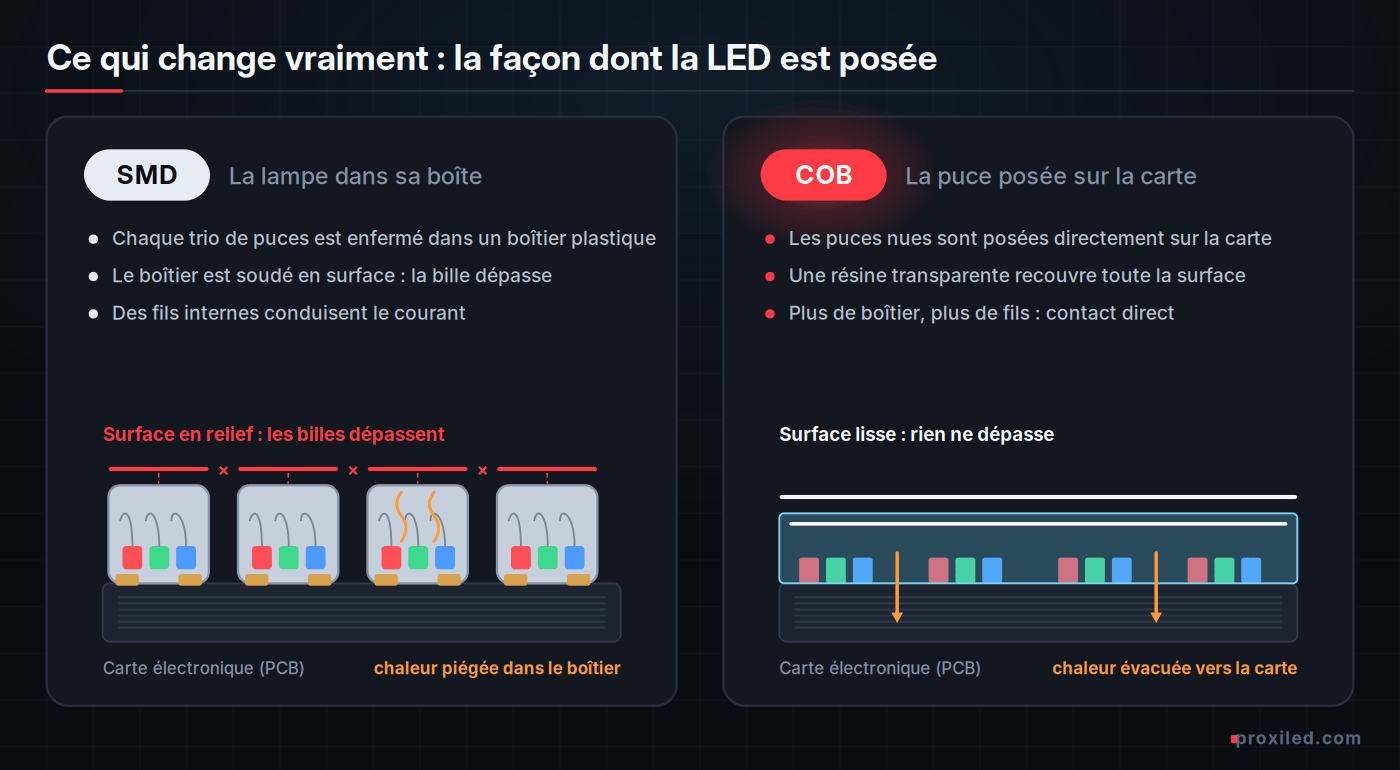
SMD: the lamp in its box
SMD is the conventional technology, used in the vast majority of screens installed today.
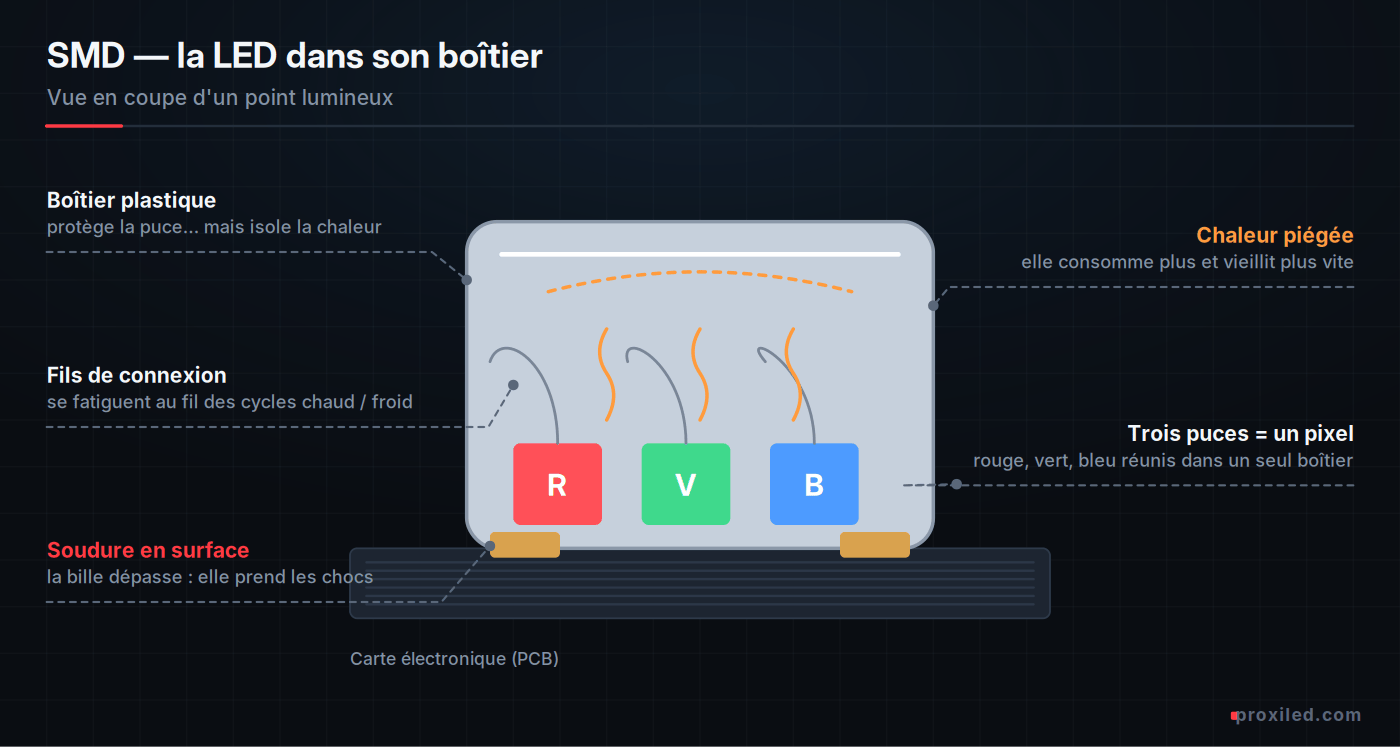
The principle: each trio of chips is first enclosed in a tiny transparent plastic package, with fine wires making the contact. This finished package, known as a “bead”, is then placed and soldered onto the surface of the circuit board.
The picture to remember: imagine thousands of tiny bulbs, each screwed into its socket, lined up on a wall.
It is a mature, well-mastered technology, mass-produced for fifteen years. It is reliable and affordable. But by design, it has three weaknesses.
The beads stick out. They sit on the surface, so they are exposed. A knock, an impact during assembly, a ball, a slightly heavy-handed clean: the bead breaks and you have a dead spot on the screen.
The plastic traps heat. The package insulates the chip from the board. The heat produced does not dissipate well. And an LED that runs hot consumes more and ages faster.
The wires wear out. Inside the package, fine metal wires make the contact. With hot-cold cycles, they eventually weaken. It is a classic cause of dead pixels after a few years.
COB: the lamp mounted directly on the board
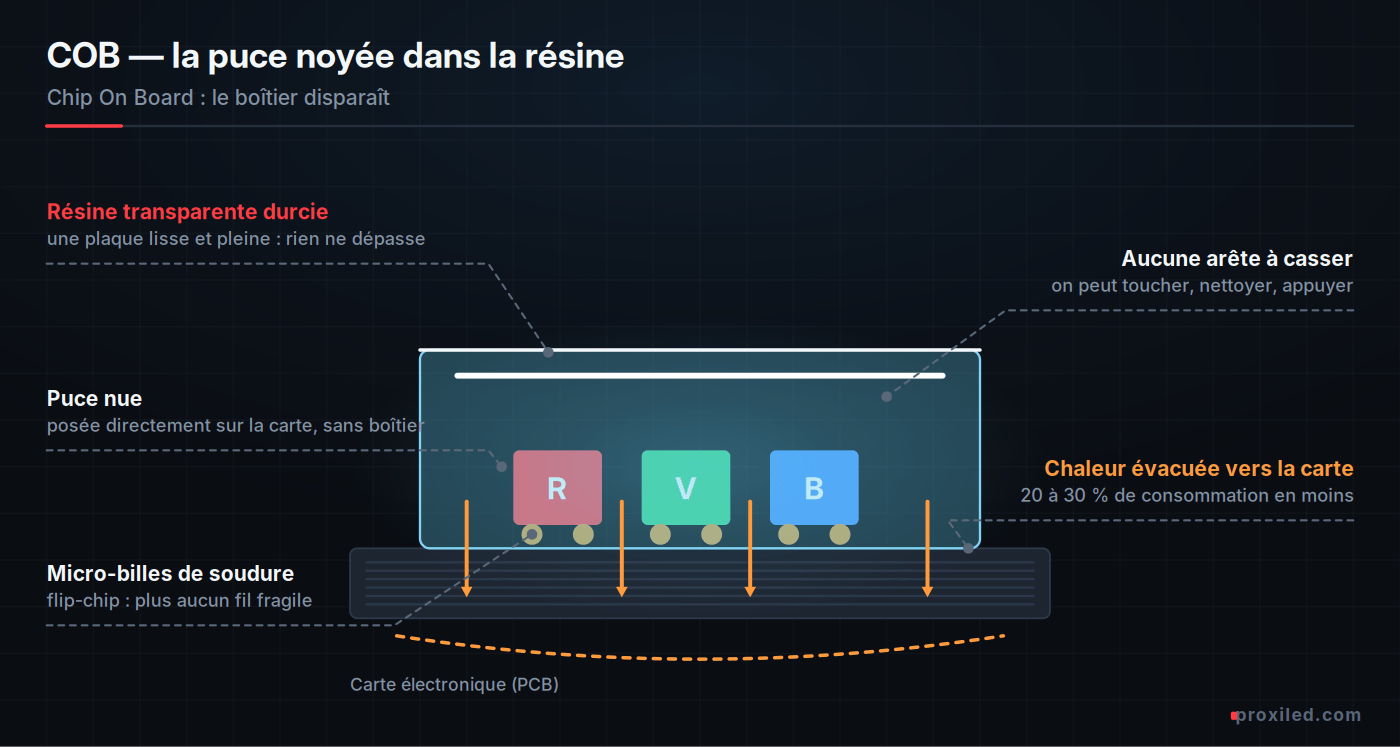
COB stands for “chip on board”. The package is removed.
The bare, unpackaged chips are placed directly on the circuit board. The whole surface is then covered with a transparent resin that hardens. The result is a smooth, one-piece panel, with nothing sticking out.
The picture to remember: instead of bulbs screwed into sockets, you have a cast glass plate with the lights set inside it.
This change in manufacturing solves all three problems at once.
Nothing left to break. The surface is flat and solid. You can touch it, clean it, lean on it. For a screen that is handled often, or installed at eye level in a public place, this is not a nicety, it is a guarantee of durability.
The heat goes into the board. Without an insulating package, the chip is in direct contact with the substrate that dissipates the heat. The screen runs cooler. A cooler screen consumes less for the same brightness, and it lasts longer. Manufacturers claim 20 to 30% lower consumption at equal brightness.
No more fragile wires. In the latest versions, known as “flip-chip”, the chip is flipped over and soldered directly, with no bonding wire at all. The part that used to break is simply eliminated.
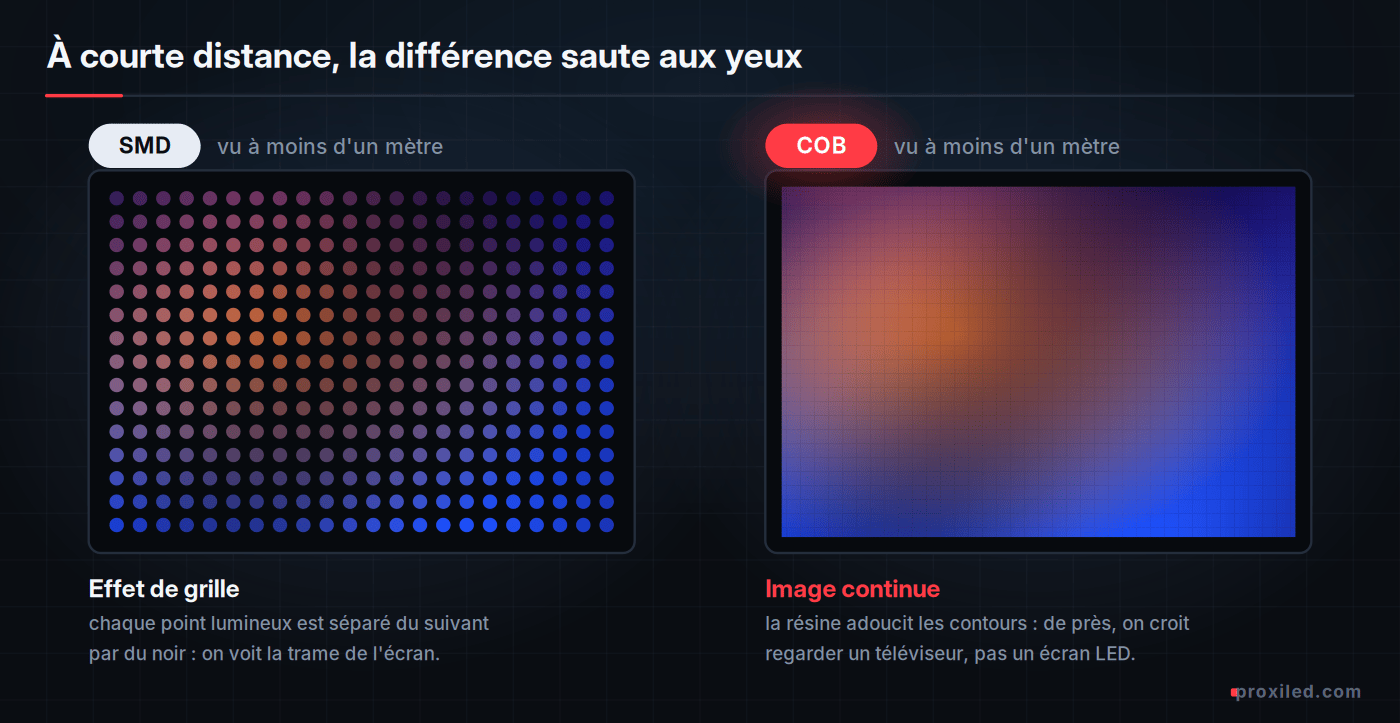
Another benefit, less technical but very visible: the resin softens the contrast and removes the grid effect. Up close, a COB screen looks like a television screen. An SMD screen looks like an LED screen.
The summary, line by line
- Manufacturing. SMD: packaged LED, surface-soldered. COB: bare chip, embedded in resin.
- Surface. SMD: textured, exposed beads. COB: smooth and solid.
- Impact resistance. SMD: low. COB: high.
- Heat dissipation. SMD: average. COB: good.
- Power consumption. COB: 20 to 30% lower.
- Close-up image. SMD: visible grid effect. COB: seamless image.
- Purchase price. SMD: lower. COB: higher.
- Industrial maturity. SMD: very mature. COB: rapidly becoming standard.
So, in practice, which should you choose?
There is no right answer in general. There is a right answer for your situation.
COB is the obvious choice when:
- The screen is permanently installed and runs all day. The electricity savings end up exceeding the extra purchase cost.
- People pass close to the screen, within three metres. Reception hall, showroom, shop, place of worship. That is where the SMD grid effect shows.
- The screen is likely to be touched, knocked or cleaned often.
- You want an image finesse that SMD can no longer deliver. Below 1.8 mm between points, SMD reaches its physical limits.
SMD remains the right choice when:
- The screen is viewed from a distance. At the roadside, fifteen metres away, nobody will ever see the difference in image quality. Paying for COB would be paying for invisible quality.
- The screen is used intermittently. An event wall that runs twenty days a year will never recoup the energy savings.
- Budget is the main constraint and use is moderate.
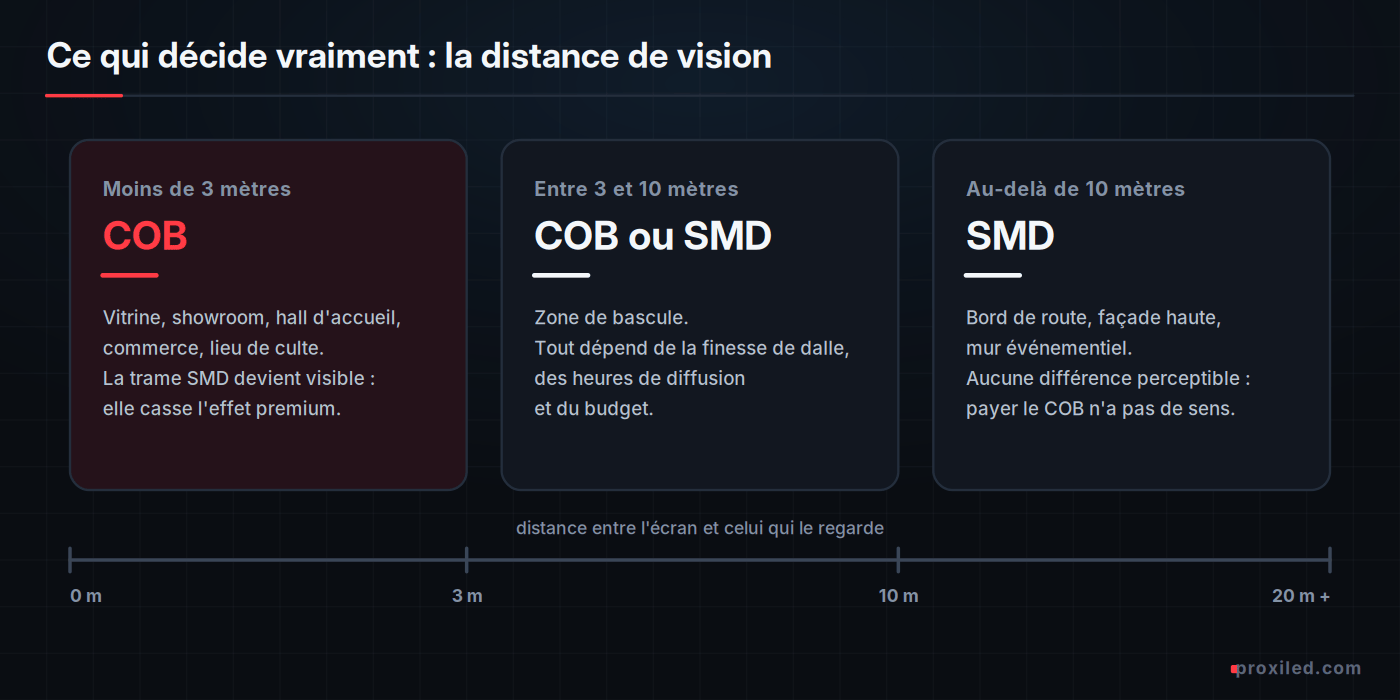
The one question to ask
An LED screen quote can never be compared with another until you have this information:
“Is this panel SMD or COB, and what is its average consumption in watts per square metre?”
Two quotes showing the same price per square metre can hide two different technologies, two different lifespans and two electricity bills that have nothing in common. The price won't tell you. This question will.
Unsure about a specific project?
Describe the location, the viewing distance and the broadcasting hours. I will tell you which of the two technologies is right for you, and explain why. Even if the answer is the one that earns me the least.
Pierre Duquesne, Proxiled
+32 479 75 13 73
proxiled@gmail.com